Big Day Today

I get my new stem cells today. This follows what was supposedly a day of rest, that really didn’t feel very restful. I woke up nauseated and that continued all day. Plus the shakes in my hands, which was a little scary. The shakes are lessening but are definitely still there. Hopefully my Cheerios won’t all fall onto the floor this morning. I felt like Trump two handing his water bottle yesterday.

I am feeling the way one might feel after six doses of chemo. The melphalan that was infused the day before yesterday is sort of kicking my ass today.

The organization that administrates and coordinates the stem cell gathering is called Be The Match. It’s an amazing organization. They’ve put me in touch with a guy who had the transplant eight years ago. He told me all about his journey, the ups and downs, the changes that happened to his taste. He couldn’t eat chocolate for about a year. Jen and John swear I’m going to like beets and tomatoes after all this and the thought of that makes me want to vomit.

Last week they told me the donor is somewhere in Europe. The collected stem cells are being couriered over to the US. By a person, so it doesn’t get lost. Not something I’d want to leave to UPS or FedEx. I’m thinking about the coordination and expense of it all.

Check out www.Bethematch.org. They are an amazing organization.

I am nervous, excited, terrified all rolled into one. The nurses have been telling me today is my new birthday. The chemo has destroyed my immune system and now I’m taking on stem cells to develop an immune system from the ground floor. In many cases the HLA matches between siblings so I would know who’s stem cells I’m getting but my brother was a half match and the random European is a perfect match. I hope he or she has awesome personality traits, because I really don’t know how life is going to change for me.

I’m wearing a green shirt today to symbolize growth.

Stir Crazy

Four days in, I figured I’d give y’all an update. As you can see, the view outside my room is spectacular. If this were a condo instead of a hospital room, I’m sure it would bring top dollar. Across the street from the Tower where I am, there’s a helipad on top of the main hospital, so several times a day a helicopter hovers and lands. It’s cool to look down on a helicopter while it’s landing. Highly recommend.

I’ve had three dose of the chemo that’s not the scary one. That one will be tomorrow night. I will have to keep ice in my mouth the whole time. Some lovely friends are bringing me in popsicles so yeah me.

I’m dropping weight every day. Some I’m sure is the chemo, but I just don’t have an appetite. It’s sort of weird.

The nurses, with the exception of one, have all been very nice. One older lady was a bit of a scold at first, but she turned out to be competent and pleasant overall. She helped me cover up my central line so I could take a shower, which felt great. The night nurse for the last two nights will terrorize my dreams. The first time she was hooking up the chemo I was traumatized because it appeared that she didn’t know what the fuck she was doing. I brought this up with my day nurse yesterday, but due to staffing she was also my nurse last night. Last night was a little less terrifying. I think she got a good talking to. She wasn’t all that pleasant, but she fumbled less.

I started on the anti-GVHD medication today. Graft Versus Host Disease is when the new stem cells attack the old cells-basically there’s a turf war for my body. GVHD can manifest in a number of ways-predominantly rashes, but it can impact different parts of the body as well. There’s acute GVHD and chronic GVHD. I’m really afraid of the concept of chronic GVHD-it sounds as awful as long COVID.

GvHD happens when particular types of white blood cell (T cells) in the donated stem cells or bone marrow attack your own body cells hence the turf war. This is because the donated cells (the graft) see your body cells (the host) as foreign and attack them. Normally T cells don’t attack our own body cells, because they recognize proteins on the cells called HLA (human leukocyte antigens). We inherit our HLA from our parents. Apart from identical twins, HLA is unique to each person.

Luckily my donor’s HLA markers were a near perfect fit with mine. After a transplant the bone marrow starts making new blood cells from the donor stem cells. These new blood cells have the donor’s HLA pattern. They recognize the HLA pattern on existing body cells as different (foreign) and may begin to attack some of them.

It’s a four-hour IV drip of a drug called Prograf twice a day at the beginning. I’m gonna get real good at walking around with my IV pole. This concludes the biology lecture portion of today’s entry. Thanks for checking in.

Opening Night Jitters

Mark and I got me checked in yesterday at Emory University Hospital, or as it’s been nicknamed the Winship Inn and Suites. We got there at 9:15ish. We were led back to a room where I was instructed to take off my shirt and put on a gown. I was still sort of loopy because I had gotten up so early, so I lay back on the bed and Mark tried to make himself comfortable in a high back chair.

She’Maia came in to insert the IV. She’Maia was unsuccessful. She went to get the charge nurse. The charge nurse tried to find a vein twice with a needle and SHE gave up- telling me that Judy the ultrasound nurse was going to look for veins with a machine. Judy applied the cold ultrasound jelly and found a vein around my right elbow. She proceeded to stick the needle in and maybe I tensed up? Because on attempt number FOUR she was unsuccessful. She sort of blamed it on me. As you might imagine, getting stuck like a pincushion did wonders for my stress and anxiety level. Finally on attempt number FIVE, Judy was successful. By this point I have bandages on both hands and three additional Band-Aids on.

After what felt like an interminable wait, I was finally wheeled back into a freezing little procedure room. Early early hip hop, like Heavy D and LL Cool J blasted on a speaker, which calmed me down a little bit. Then the fentanyl and versed that the nurse Kimberly gave me calmed me down even more. The guys got me all covered in drapes and swabbed down with more freezing cold liquid. The doc (Mark says interventional radiologist sounds better) came in and quickly inserted the central line so I don’t have to keep getting a bunch of needles stuck in me. There were about five seconds of pain, but then it was over and the techs bandaged me up. The central line insertion was quick and almost painless and not nearly as scary as I had envisioned.

I was wheeled back into the room to come down from the fenty/versed cocktail. There was another waiting period that felt like forever and then I was wheeled from the main hospital to the Tower where I’ll be for four weeks. We finally got up to the room around 3:00 pm.

I’m going to be in the hospital for at least four weeks.

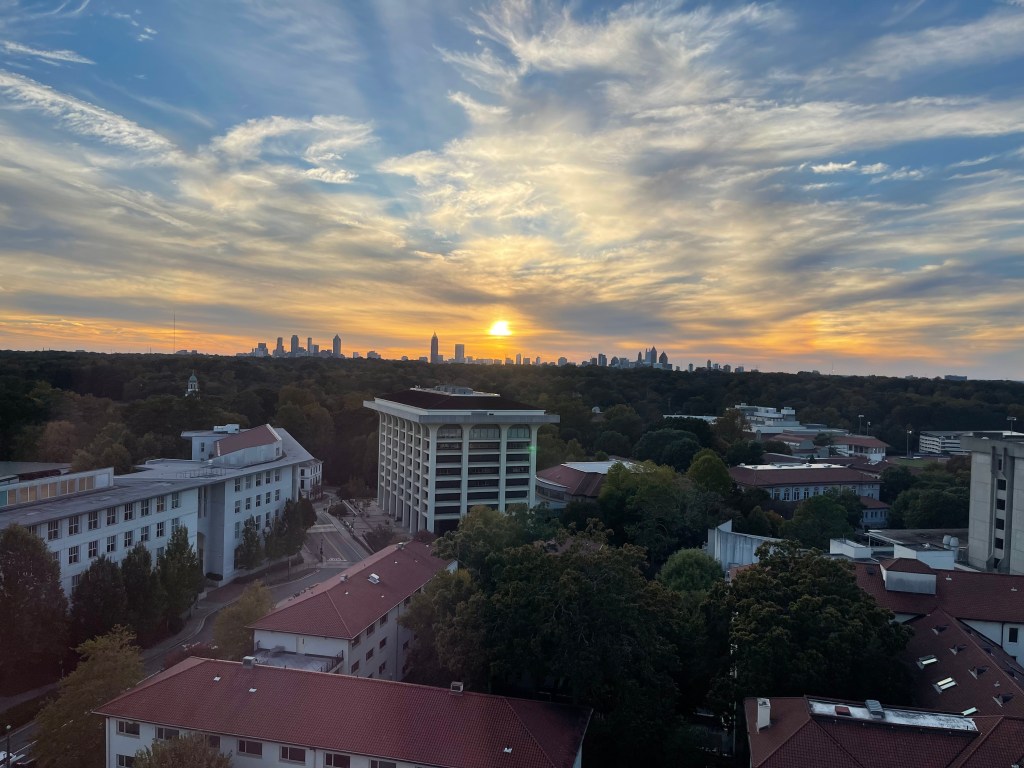
My room isn’t horrible. I have a spectacular view looking out over Emory with the Midtown skyline on the horizon line. The room has a bed, a couch, a LayZBoy chair, another chair and a rolling table that functions as a desk, dining table, medication prep table. The table raises and lowers and the top slides over to increase the flat surface. real estate. Dr. Kauffman and Dr. Muniz came in to introduce themselves and left me in the capable hands of nurse Mary and nursing student Mary. Everyone was friendly and nice, especially the Marys. The Marys came in periodically to ask questions, take my blood pressure, etc. and Dr. Muniz spent a good amount of time talking with Mark and me-about the timeline and the process. It was one of those situations where at the end of our conversation he asked if I had questions and I had taken in so much information that I was too overwhelmed to ask any. Drinking from a firehose.

The sun set and the night nurse Duran came on. Again, a super nice guy. Mark hung out with me until 8:30 because Duran told me that my first round of chemo wouldn’t be administered until 10:30 pm. A tech stopped by to instruct me on some wipes I have to use daily to reduce infection. One wipe for one arm, another wipe for the second arm, one for the left leg, one for the right leg, one for the torso and one for the back. The swabs were warm at least, and the tech, Jackie swabbed my back for me. I had thought it was going to be an imposition, but it turned out to be nothing.

Duran came in around 9:30 pm and gave me a couple of pre-chemo drugs. Everything went into the central line and I didn’t feel a thing.

Duran then came in and spent fifteen minutes getting the chemo set up. He put on a gown and gloves before touching the chemo bag. The cocktail I’m getting is called fludarabine. The bag was small like a juice box. He finally turned the machine on and I was off. It was sort of anticlimactic. The chemo took thirty minutes, there was another line flushing that took around fifteen minutes. I have three more days of this regimen and then the final day I get the scary one that’s I think has all the side effects.

Today I feel fine, I have an appetite, I get to go outside for the first couple of days and Mark is here with me today. After the initial trauma my first day went well. One down and hopefully only thirty more to go.

Uncomfortable Answers

It might give more perspective if you read the post immediately following this one before reading this one.

I’m going to simplify this as much as I can. Dr. Pandit diagnosed me with MDS. Myelodysplastic syndrome-MDS is a rare precursor to blood cancer that inhibits production of blood cells. My red blood cells are the ones that aren’t being manufactured correctly. Left untreated, there’s a strong chance that MDS can develop into leukemia. The good news is that my MDS was caught early.

For this reason, he referred me to Winship Cancer Institute at Emory University Hospital.

At my first appointment with Dr. Amelia Langston, she had reviewed the report from my bone marrow biopsy and didn’t see evidence of what she called a “smoking gun,” a clear set of signposts for MDS. She asked if I’d ever been overseas. I told her that I had travelled extensively outside the U.S., but the bulk of my travel was over ten years ago. She suggested I go to an infectious disease doctor, and then to a rheumatologist, to see if they could shed any light on what the hell was going on. They couldn’t find any problems.

At the same time Dr. Langston told me that she would request further examination of the bone marrow biopsy sample I had at Piedmont Hospital including more notes and questions from the pathologist due to my skin lesions and inflammation, specifically relating to a syndrome called VEXAS.

To put this simply, Dr. Langston’s request for more information from the biopsy showed that I have VEXAS. It sounds glamorous. It’s far from it. VEXAS is a newly discovered, extremely rare syndrome, and it’s what’s causing the MDS. The name VEXAS is actually made up from the first letters of each of the unique qualities that differentiate it.

The V is for Vacuoles-lipids present in the immature red blood cells.

E is for the E-linked enzyme, which is integral in correct formation of the blood cells that’s being inhibited by a genetic mutation.

X refers to the X chromosome-men only have one X chromosome so men are more susceptible to the malady.

A refers to autoinflammatory response-which means that one of the determinant factors of VEXAS is inflammatory responses, that I can trace back to my right testicle, my left eye and all the pop up inflammations that I’ve soldiered through.

The most insane of all is the S-it stands for somatic-meaning that sometime after I was born I experienced a genetic mutation.

I keep wracking my brain to come up with when this UAB-1 genetic mutation might have been unleashed in my body-was it from working around radioactive materials when I was in the Air Force? Was it an HIV Vaccine Clinical Trial I participated in at Vanderbilt? Too much ibuprofen?

It’s a good news/bad news situation. The good news-actually great news-is that after six months of not knowing what craziness was going on in my body, we finally know what the culprit is. There is some less good news. The only treatment at the current time to keep VEXAS from advancing is a bone marrow transplant. Once the decision was made that I’ll be getting what’s actually a stem cell transplant, Emory already has a donor sample with ten HLA markers that line up with mine, so there’s already a donor available that I’m compatible with.

As long as all the stars align, I’ll be checking into Emory Hospital Friday October 20th to begin the preparation for the transplant. The process is amazingly complicated but it’s gonna keep me around until I’m old.

Even though it’s going to be difficult, and I go through waves of anxiety on the regular, I’m doing my best to keep a positive outlook. I have a lot to be thankful for. It helps that my husband Mark is a Nurse Practitioner and is the kindest person I have ever met. I have a donor already lined up who can donate his stem cells within the timeframe needed to make this all happen. I live close enough to Emory so that if anything comes up, I’m a 20-minute ride from the hospital. I have tons of support and love coming from family and friends.

So yeah, I’m a lucky man.

The Definition of Scary

In the beginning of the year 2023, unease came to settle on our household. It all began with anemia. After my physical in October, Dr. Patrick Coleman, my primary care doctor asked me to come in and retest because my red blood cells and hemoglobin count were low. I didn’t go back in because the phlebotomist must have been having a terrible time that day. Multiple attempts to hit a vein left me bruised, bloodied and traumatized. I have had a lifelong fear of needles.

I developed a burning stomach pain, concentrated in a very specific area. I couldn’t sleep. The thought of eating made me nauseated. I made a visit to a Piedmont clinic where a nurse practitioner named Vickie prescribed several different pills. She also drew labs and called me the next day to inform me that my red blood cells and hemoglobin numbers were even worse than they had been.  Because of my stomach pain she suspected I had an abdominal bleed. She advised me to get in touch with Dr. Quinn, my gastroenterologist, who scheduled me for an endoscopy and a colonoscopy.

At the same time, my left testicle swelled up to three times its normal size over a three-day period. My friend Jeff, who works in urology determined that the swelling didn’t appear to be a tumor. Mark scheduled me for what turned out to be the most terrifying ultrasound possible with a tech who scanned my testicle. I felt exposed, scared and mortified. The good news was that there was no tumor. The diagnosis was epididymitis, an inflammation of the tubes down there. Mark prescribed me antibiotics and ultimately the swelling decreased.

My stomach pain decreased about the same time as my endoscopy/colonoscopy, which found absolutely nothing wrong. Dr. Quinn then scheduled a CT scan, an MRI and a pill cam. With a pill cam you wear a receiver on your belt. You then swallow a pill that has a camera in it, and as the pill travels through the small intestine it takes a bunch of pictures that the receiver attached to your belt picks up. At the end the pill travels the rest of the way through the digestive track and ultimately ends up getting flushed. None of the tests showed any abdominal bleeding.

Then the eye situation happened.

The burning pain in my abdomen started throbbing again, but in a totally different area of my stomach. I again went to the Piedmont clinic for an appointment with a different NP, who had the bedside manner of a gravedigger and was a dead ringer for Republican Representative Lauren Boebert. In the short time she spent with me she refilled the same prescriptions that Vickie had prescribed and wrote the order for labs.

Later that day I got an alarming message through the patient portal from the unpleasant NP that my hemoglobin was dangerously low and that I should go to an emergency room for a blood transfusion. My hemoglobin was hanging out in the 8 range, which while not good didn’t facilitate he need for a blood transfusion. The NP called me the next morning and harangued me about not monitoring my hemoglobin and why hadn’t I gone to an emergency room for blood. I refused. She told me I needed red blood cells. I told her that I was not convinced that my numbers warranted a crisis just yet. She ended up writing me a referral to a hematologist.

After the glaucoma situation leveled off, strange inflammations began occurring. A random area on my arm or leg would get hot and swell and generally feel terrible. I could always tell when a new one was coming up because I would feel feverish and tired. As soon as the heat and swelling from one inflammation would start to decrease, another would begin to form in a different location. It was inflammation whack-a-mole. My ability to walk normally was impeded. It was scary as hell.

I was sent to several different doctors, a GI doc, a rheumatologist, an infectious disease specialist and a hematologist. I had X-rays, ultrasounds, CT scans, MRIs and was finally sent to Piedmont Hospital for a bone marrow biopsy.

None of the doctors could tell me what was wrong.

Other than colds and an occasional flu, I never get sick. I grew increasingly alarmed.

My hematologist Dr. Pandit finally identified something called MDS-myelodysplastic syndrome as the culprit for my anemia. My bone marrow is producing white blood cells and platelets just fine but not producing red blood cells correctly.

This diagnosis did nothing to explain the inflammations. Modern medicine has a tendency to be siloed. Each discipline stays in their lane, knows the ins and outs of their specialty but hasn’t received training and experience for stuff outside of their realm of expertise.

Dr. Pandit referred me to the Emory University Hospital for an appointment with Dr. Amelia Langston, who’s over bone marrow transplants. That’s when things got really bizarre.

Unnerving Visions

It’s ironic that my final post from 2019 was about eyes. The first thing I should report is that I got out of the eye business. In March of this year, over the course of three days I came dangerously close to going blind in my left eye.

On a Monday morning in March, as I prepared for work, I felt a little pressure or something in my left eye. There was also an itch, so I assumed I had scratched my cornea. I went on about my day.

When I woke up Tuesday the pressure had increased instead of going down. I was popping ibuprofen like a fiend but it didn’t seem to help. The eyeball throbbed and got progressively more sensitive to light. The pain steadily increased, as did my anxiety. I thought to myself that maybe it was a sinus reaction or something but in the back of my head I started to suspect that something was very wrong. Mark told me I should go see my eye doctor.

Wednesday morning the headache, pressure, pain and sensitivity were worse. I called Mark when I got to work and he made me see that my eyes should not hurt He confirmed my suspicion that something was really wrong. I called to see if I could get in to see my optometrist, Dr. Saadat at Tulman Eye Group. As luck would have it, when I called, Dr. Saadat was in the office that day (he only works a few days a week.)

I arrived at Tulman and was quickly brought back to a testing room by Kat, my favorite tech that works at the practice. We’ve got history, so we usually cut up while she’s taking readings and measurements but on this day she could see the redness and swelling so we got right down to business. I told her about the headache and the light sensitivity. She tried to hide her concern but she’s not an actress.

I read the charts and looked at the air balloon (one of the tests) and we determined that my eye was functioning properly. Then she did the pressure test. When she took the reading in my left eye the room got very silent. All joking and casual chat ceased and the air got very heavy. She stood up and walked me to the waiting room. I asked what she’d discovered and she said that Dr. Saadat would have to tell me.

I didn’t even get to sit down in the waiting room before I was whisked back to Dr. Saadat’s exam room, which had never happened. Dr. Saadat was already in the room, which again was unusual. He motioned for me to sit in the chair and started, dispensing with any pleasantries.

“You’re having a medical emergency. You have acute closed angle glaucoma in your left eye. Your eye pressure should be around ten to twelve. Yours is fifty-one. I’m getting you into laser surgery today. The doctor will need to do both eyes as there’s a 95 percent chance that the same thing will happen in your other eye.”

My head was reeling. I had developed glaucoma over a three-day period. The iris (colored circle) drains fluid into the the sclera (the white portion of the eye) through a series of channels. Internal eye photographs showed my channels totally blocked in my left eye. There was no place for the fluid to escape, forcing the pressure to build and build.

Dr. Saadat started putting drops into my left eye. Then he put more drops into my left eye. During that time the receptionist came into the office and said the first appointment for the laser surgery was in April.

“Yeah, no. I’ll call him.” Dr. Saadat retorted and called Dr. Arkadiy Yadgarov the ophthalmologist on his cell. Miraculously, he got me scheduled for a laser surgery later that day. I called Mark and my boss at the time to let them know what was going on.

Two hours later I’m at Omni Eye Services getting several more liquid fire drops put into my eyes. I was then led into the laser surgery suite. I felt like a condemned man walking to his execution. The laser machine sat on a tabletop. It had arms, braces, leather straps and made a high-pitched whine. My fear felt like a physical thing. The tech silently pointed to sit in front of the beast that was about to shoot lasers into my eyes. Dr. Yadgarov came in, introduced himself and sat at the other side of the desk. I don’t remember a word he said. I could not see his face because of a mask. I could only focus on the scary machine I was inches away from. After what seemed like an hour but was probably three minutes, he told me to lean forward and put my chin on the leather strap. He signaled to the tech, who proceeded to HOLD MY HEAD against the machine so I couldn’t move. The doctor told me not to blink (yeah, right.) Some internal device inched forward and I could feel it physically touching my left eyeball. He proceeded to fire laser pulses into my left eyeball. I received twelve or so laser beams to create the hole in my iris so the ocular fluid could drain. Twelve laser pulses into an already painful eyeball was as excruciating as it sounds.

Meanwhile I can’t move or twitch because I was being physically held against the behemoth. I honestly couldn’t tell how long the process took. It might have been two minutes or twenty minutes. The doctor tinkered with the device; the tech repositioned my head against the strap. Again, the doctor told me not to blink, adjusted the device to touch my right eyeball and proceeded to fire twelve or more laser pulses into my right eye. All the while the tech kept me immobile, her hand against the back of my head holding my face against the machine.

When it was over, I was led out of the room into a hallway where Mark and our friend Kate were waiting to drive me home.

In my naivety I assumed that I’d immediately begin the healing process. That didn’t happen. As I lay prone on the couch waiting for the pain to decrease the pain didn’t decrease. Not only did I have the pressure, but now there was burning inflammation pain. My left eye became so swollen I couldn’t close my eyelid over it. It turns out that I had a reaction to one of the fifty different eye drops that the doctors had used in attempt to decrease my ocular pressure.

Saturday morning I went back to Tulman Eye Group where Dr. Tulman checked my eye pressure. My left eye pressure was down to thirty and the right eye was at eleven. Dr. Tulman told me to return on Monday and prescribed a different medicine, another volcanic eye drop. Saturday evening, I began to feel a lessening of the pressure. Sunday I could feel the pressure reducing a little more and the pain from the inflammation decreasing. I was able to close my eye again, which was a huge relief. Monday morning, I again went to Tulman where Dr. Tranh checked my pressures. The pressure in my left eye had dropped to fifteen. The inflammation had also lessened a bunch.

I was tenuously on the road to recovery. The quick actions of Dr. Saadat and Dr. Yadgarov saved me from going blind in my left eye, my dominant eye. If Dr. Saadat hadn’t pulled some strings and asked for a favor I wouldn’t have gotten the surgery I needed that day, and while it the process was indescribably painful, I came out of the situation with the same vision I had prior to the whole experience. The inflammation that resulted was a direct by-product of attempts to save my vision.

Every morning and evening I put a drop of that liquid fire into each eye, but it’s consistently kept my ocular pressure down. It burns every time, but with every drop I am reminded of those terrible day when I almost lost the sight in my left eye.
Some things I think about eyes.

According to the family mythology-my Mother being an avid spinner of tales and embellisher of truths-when I was fitted for my first pair of glasses I looked up into the sky and was electrified by seeing stars for the first time. I’m extremely myopic-meaning my ability to distinguish objects up close is basically crap, but it turns out my distance vision was awful as well. Judging from the thickness of my current lenses and the amount of correction I need to see, putting on my glasses for the first time was probably like entering a strange new world. I wish my parents had had an iPhone back then to capture my alarm and wonder.

Working with eyes means I obsessively think about eyes, how they function for the people whose face they are in and the hundreds of external functions they also have. Eye contact is an integral way for us as people to connect with other organisms. We’re taught there is no substitute when creating and promote a trusting connection than looking another person in the face. You’re thought to be sincere and trustworthy merely by the physicality of your eyes and how they sit in your face. Whole conversations occur between people sometimes without words needing to be spoken, all because of cues taken from a person’s eyes. Our pupils expand and contract, tears well up, a simple change in the direction eyes are facing can say so many different things. Physical attraction? It’s conveyed with the eyes. Subsequently there’s a huge industry tasked with making eyes more alluring, more captivating.

Our irises, which give us our individuality, vary in shade and hue and depth. A pigment called melanin is the cause. People with blue, green and gray eyes have lesser amounts of melanin, and researchers posit that 10,000 years ago everyone had brown eyes. As people started diosporia-ing off from Mesopotamia there wasn’t the same need for larger amounts of melanin to protect against UV rays, so human genetics selected and populated new eye colors with less and less melanin content.

I heard a story this morning about a friend who somehow detached his retina from the back of the eyeball. The retina is this elegant silky layer on the interior of the eyeball that takes what you see and codes it into neural signals that are delivered into the brain to be decoded.  Because the retina has such an important function, retina specialists make a lot of money. Hearing about my friend created a scary place in my head. I’ve always been squeamish about my eyes, perhaps because it takes so much assistance for mine to work correctly. Before I put my glasses or my contact lenses on in the morning I’m not able to make my way in the world. The thought of getting something in my eye freaks me out to no end. I threw up in Art History class when we were forced to watch Un Chien Andalou, the Dali/Bunuel film that starts out with an eyeball getting sliced with a razor. I’m getting squigged out thinking about it. 

The concept of a cataract surgery, where a surgeon cuts into the eye and destroys an integral part of the eyeball before sucking out that little part and inserting a clearer, not scratched or cloudy part was enough to send me racing to the toilet. That was until I got to see the surgery up close. Cataract surgery is elegant-quick, pain free and can restore and improve a patient’s sight. Being in an operating room, seeing the orchestra of an ophthalmologist, his tools of the trade, the precision of scrub techs and nurses, the hum of machines all work together like a Swiss watch. It’s incredible to witness.

I’m working now with a company called Diopsys, which has a world-class retinal monitoring system that shows how the retina functions. Much like any complex machine, the eye will exhibit changes to function before any sort of structural change. Other retinal devices like an OCT (Optical Coherence Tomography) show retinal structural change, but at that point what a Doctor is looking at is dead retinal cells. Basically an OCT shows you a crime scene. The device my company makes is able to identify unhealthy cells from less than optional functionality, so that a Doctor can make decisions that can save retinal cells. I’m lucky to have the opportunity to work for a company that is integral in saving sight for so many.

Because of the shape of my eyeballs and the complexity of my prescription I’ve never had contact lenses that did the job-either they did the job for distance or they did the job for close up. And when I turned 40, the age when nearly everyone loses focusing ability for near vision what was bad already got way worse. Imagine my delight when my new optometrist said he could design a custom set of lenses for my eyes. What he designed has radically changed how I see. I can read close up with no reading glasses. I can make out stuff at a distance I wasn’t able to before. It’s been truly life changing. By integrating a multi focal capacity to my new lenses my vision is like never before. It’s been one of the best things that have happened for me in years. A whole new world has opened up for me again.

The new beehives

Yesterday Cynthia and I set out bright and early for a trip to Sparta GA to get two bee nucleus colonies. One of our hives decided to fly the coop (hive?) over the winter, so we drove two hours east to the outskirts of Egypt to pick up new beehives. New beehives come in nucleus colonies. A nucleus colony (nuc) contains a Queen, a bunch of workers, a bunch of eggs and some honey for the bees to snack on while they get situated in their new home.

ExploreGeorgia.org says the following about Hancock County, where Sparta is situated: “…is home to an estimated 600 historic sites, which are reflective of a rich American Indian, European and African American history and culture. A journey down Sparta’s streets and Hancock County’s back roads provides a glimpse of the romantic past, recalling the days when cotton was king.” If that doesn’t sound like coded language I don’t know what does.

Our trip was delayed a bit due to biology. After two hours in the car drinking coffee both of us were looking very forward to a pit stop. We learned, however that a water main had broken somewhere nearby the exit, and after stopping at a gas station, two fast food restaurants and a Home Depot and getting rebuffed each time we white knuckled it and drove on, hoping and praying for a solution. We were rewarded several miles down the winding road.

My lovely friend Mary lives on a big farm out off Pumping Station Road, just past the Shoulderbone Plantation. She raises bees and her husband Jeff owns and manages a huge loblolly pine operation. Loblolly pines are considered the most commercially important trees in the Southeastern US. The lumber is used in basically everything construction related-furniture, plywood, pilings, pallets and boxes. The mulch in your yard probably consists of loblolly pine. Jeff’s operation is significant.

We picked up the bees, which are in two specially designed cardboard boxes and set off back to East Point. As we got onto 285 heading home a bee buzzed up towards the windshield. So now I’m navigating horrendous Atlanta traffic wish a loose bee buzzing around less than two feet from our faces. Cynthia and I talked to her and tried to keep her calm-putting ourselves into her shoes (wings?)realizing how stressed she probably was-a country girl in the big city for the first time.

We made it home without incident. I got the girls situated in their new spots in Cynthia’s backyard. When orienting a new hive, the rule of thumb for a nucleus colony is to open a small door on the front of the nuc box to allow ventilation and to allow the more adventurous bees to bop around the surroundings, and go back and install the frames into a brood box at a later date. Opening the front door, the bees flooded out. The original plan was to go back today and transfer the frames into the permanent brood box.

Today it’s raining and storming and windy and disgusting, so we’ve had to regroup and modify our strategy. It might have to be tomorrow.